₿ BITCOIN47.COM
What Is Fiat Money and Why Does It Matter?
Fiat currency explained: how money works, how central banks create it, why fiat always debases, and what Bitcoin changes. Economics for Bitcoin holders.
"Give me control of a nation's money supply and I care not who makes its laws." — Attributed to Mayer Amschel Rothschild, whether accurate or not, it describes something real.
To understand why Bitcoin matters, you first need to understand what money is, how fiat money works, and what its structural properties mean for everyone who earns, saves, and spends it.
- →The three functions of money and how Bitcoin performs on each
- →What fiat money is and how it differs from prior monetary systems
- →The three tiers of money creation: central bank, commercial banks, Bitcoin
- →Why fiat systems structurally debase — the incentive structure
- →Every fiat currency in history: what happened and why
- →Sound money vs. fiat: the Bitcoin comparison table
The Three Functions of Money
Economists define money by what it does, not what it is. Any asset that performs these three roles is functioning as money:
1. Medium of Exchange
Money lets you trade your labor or goods for other goods without needing a direct barter match. Without money, a doctor who wants grain has to find a farmer who needs medical treatment right now. Money eliminates this "double coincidence of wants" problem.
2. Store of Value
Money should retain purchasing power over time. If you earn money today, you should be able to spend it next year with roughly similar purchasing power. An asset that reliably loses value fails this test.
3. Unit of Account
Money provides a common unit for pricing things. Contracts, taxes, wages, and financial accounts are all denominated in money. This only works if the unit itself is stable and predictable.
The critical insight: fiat currencies perform function 1 excellently, function 3 adequately, and function 2 increasingly poorly over time. Bitcoin was designed to restore function 2.
What Is Fiat Money?
Fiat is Latin for "let it be done" — a decree by authority. Fiat money is currency declared by a government to be legal tender, backed by nothing but the government's authority and the public's willingness to accept it.
This is radically different from historical money:
Commodity money (gold, silver, shells, salt) — has intrinsic use value independent of government decree. Cannot be created from nothing.
Commodity-backed currency (Bretton Woods dollar pre-1971) — paper notes redeemable for a fixed amount of gold. Supply constrained by gold reserves.
Pure fiat money (modern dollar, euro, yen, pound) — paper or digital entries with no commodity backing. Created by central banks through policy decisions. Supply unconstrained.
The United States moved to a pure fiat system on August 15, 1971, when President Nixon closed the gold window — ending the dollar's convertibility to gold that had been promised under Bretton Woods. Every major currency in the world is now fiat.
How Fiat Money Is Created
Most people believe money is printed by governments and distributed. The actual mechanism is more complex — and the understanding of it is essential for Bitcoin holders.
In the modern monetary system, the majority of money is created not by central banks, but by commercial banks when they make loans. The central bank creates "base money" (reserves). Commercial banks multiply it through lending.
The Three Tiers of Money Creation
Tier 1: Central Bank (Base Money / Reserves)
The Federal Reserve, European Central Bank, Bank of Japan, etc. create "base money" — also called reserves or M0. This is the only money that exists as claims on the central bank itself.
Central banks create base money by:
- Purchasing government bonds (open market operations / quantitative easing)
- Setting the overnight interest rate that controls how much commercial banks can borrow
- During crises: buying mortgage-backed securities, corporate bonds, and other assets
Tier 2: Commercial Banks (Broad Money)
When a commercial bank makes a loan, it creates new deposit money. A bank does not lend out depositors' money — it creates new money as a digital entry. The borrower's deposit is a new liability the bank owes; the loan is an asset the bank owns.
This process is constrained (in theory) by:
- Capital requirements (banks must hold equity against risk-weighted assets)
- Reserve requirements (in the US, reduced to 0% in 2020)
- Demand for loans (banks can only create money if someone wants to borrow)
The result: The money supply can expand far beyond the base money created by the central bank. In the US, M2 (broad money including deposits) is typically 5–10x the monetary base.
Tier 3: Bitcoin (Proof-of-Work)
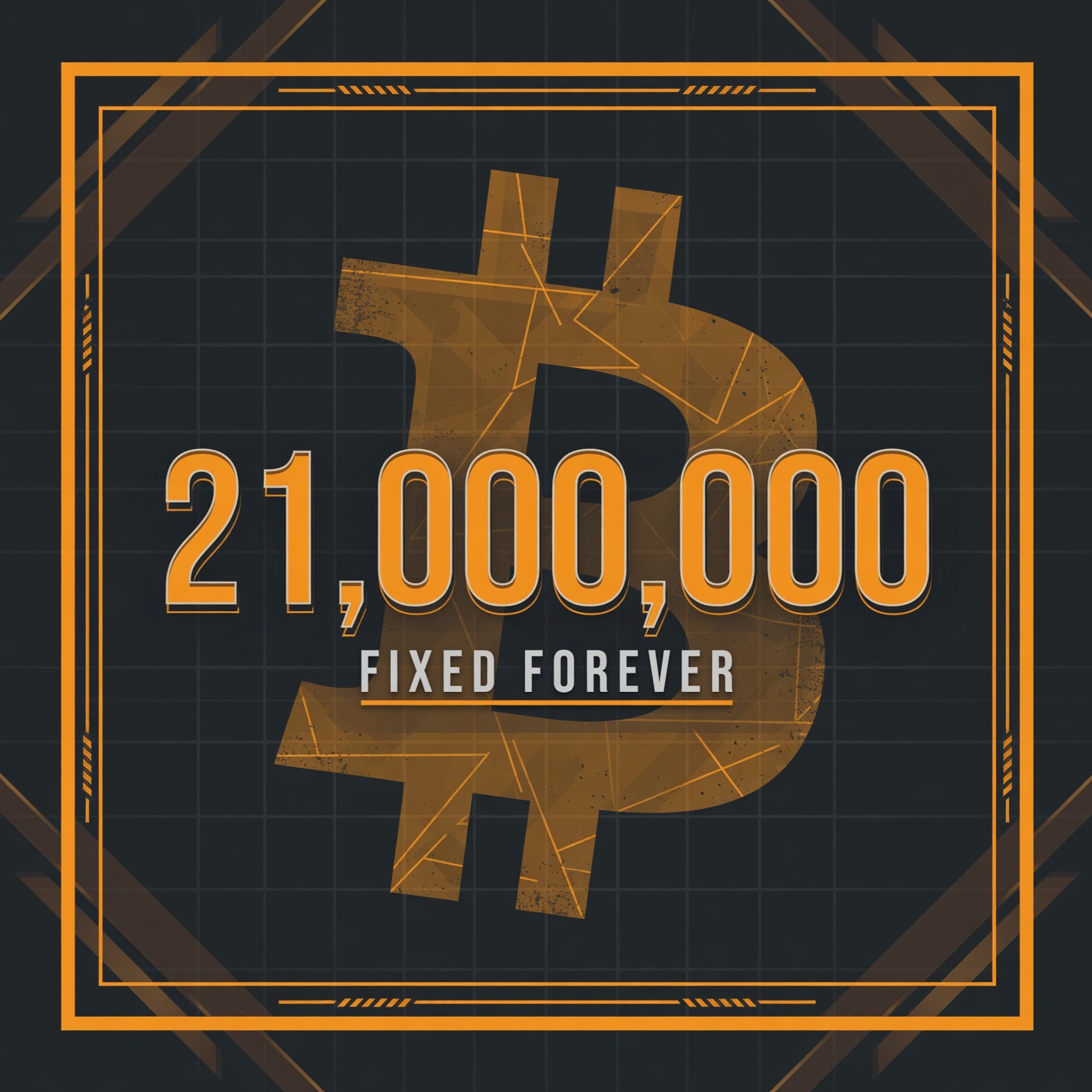
Bitcoin's money creation is entirely different. New bitcoin is created only through mining (proof-of-work), at a rate predetermined by the protocol, declining by 50% every four years (halvings), and capped at 21 million coins. No institution, no government, and no individual can change this schedule.
Why Fiat Money Structurally Debases
The fiat system creates structural incentives toward monetary expansion that are difficult to resist:
Government spending pressure. Governments spend more than they collect in taxes, creating deficits. They finance deficits by issuing bonds. When central banks buy those bonds with new base money, they monetize the debt — effectively creating money to pay for government spending.
The "inflation or recession" choice. When economic activity slows, central banks face political pressure to stimulate. Stimulation means lower interest rates and money creation. Over time, these responses ratchet the money supply upward.
Debt dynamics. Once debt is sufficiently large (see Sovereign Debt →), the only politically feasible way to manage it is inflation — which reduces the real value of debt. Governments and central banks are therefore structurally incentivized to inflate.
Time horizon mismatch. Central bank governors and politicians face election cycles and term limits. The costs of monetary expansion (inflation, asset bubbles) often manifest after they've left office. The incentive is to solve today's problem with tomorrow's money.
The result of these pressures, documented across every major fiat currency, is a consistent long-term trend toward monetary expansion and loss of purchasing power. The US dollar has lost approximately 96% of its purchasing power since the Federal Reserve was established in 1913. In the ~50 years since Nixon ended the gold standard in 1971, the dollar has lost approximately 87% of its purchasing power.
This is not a conspiracy. It is the logical output of a system designed without a supply cap.
The History of Fiat Currency Failure
Every fiat currency in recorded history has either collapsed or significantly debased. This is not a politically charged claim — it is a historical observation:
| Currency | Outcome |
|---|---|
| Roman Denarius | Debased from 90% silver (200 AD) to 5% silver by 300 AD |
| French Livre/Assignat | Hyperinflation during the French Revolution (1790s) |
| German Papiermark | 1923 hyperinflation (exchange rate: 4.2 trillion marks per dollar) |
| Zimbabwe Dollar | 2008 hyperinflation — 89.7 sextillion percent annually at peak |
| Argentine Peso | Lost >90% of value in last 5 years (ongoing) |
| Venezuelan Bolívar | Hyperinflation — government redenominated three times since 2008 |
| US Dollar (since 1913) | Lost 96% of purchasing power — gradual, managed debasement |
The US dollar is not failing dramatically — it is failing gradually. But gradual failure compounds: money saved in dollars 20 years ago has lost ~35–40% of its purchasing power by today's prices.
Sound Money vs. Fiat Money
Sound money is a monetary asset with properties that resist manipulation:
| Property | Gold (historically) | Fiat Dollar | Bitcoin |
|---|---|---|---|
| Fixed supply cap | No (can be mined) | No (unlimited) | Yes (21M) |
| Supply predictable | Roughly 1–2%/yr | Discretionary | Exactly scheduled |
| Confiscatable | Yes | Yes | No (self-custody) |
| Censorship resistant | Partially | No | Yes |
| Divisible | Limited | Yes | Yes (100M sats) |
| Portable globally | Poor | Moderate | Excellent |
| No counterparty risk | Partially | No | Yes (self-custody) |
Bitcoin is the first asset in history to combine a hard supply cap, a predictable issuance schedule, digital portability, divisibility to 8 decimal places, and censorship resistance. This combination is what makes it a qualitatively different monetary asset.
For Further Reading
Saifedean Ammous — Sound money theory from gold to Bitcoin, with detailed historical analysis of every significant fiat experiment. The single best book on monetary economics for Bitcoin holders.
Amazon →Lyn Alden — The most comprehensive data-driven treatment of fiat monetary systems and their structural fragility available to a general audience.
Amazon →G. Edward Griffin — How the Federal Reserve was created, how it operates, and why its structure creates permanent inflationary bias. Foundational for understanding the US monetary system.
Amazon →James Rickards — How nations compete through currency devaluation and what the endgame of the current global monetary system looks like.
Amazon →→ Continue: Inflation and Debasement → | Economics Hub → | Bitcoin Price Mindset →
Contains Amazon affiliate links — we earn commissions on qualifying purchases at no extra cost to you. Not affiliated with Donald Trump, any campaign, or any government office. Full disclosure →