₿ BITCOIN47.COM
Bitcoin vs Gold: Sound Money Head to Head
How Bitcoin and gold compare as sound money — supply, portability, divisibility, verifiability, and the case for each as a long-term store of value.
Two Answers to the Same Question
Gold has been money for 5,000 years. Bitcoin is 17 years old.
Both exist because of the same underlying problem: fiat currency — money created and controlled by governments — has a fundamental defect. The people controlling it can always create more. And they always do.
Gold was the world's answer to that problem for five millennia. Bitcoin is a new answer — built for the digital age, with properties gold never had and gold can never acquire.
This is not a debate about which asset is "better." Both have a role in a world where monetary debasement is the dominant force in savers' lives. But the comparison is worth doing carefully, because the differences explain a great deal about why Bitcoin has emerged as a distinct asset class rather than simply a "digital version of gold."
The Core Properties of Sound Money
Economists have long defined sound money by a set of properties. Let's run both assets through each:
1. Scarcity — How Fixed Is the Supply?
Gold: The total amount of gold ever mined in human history is approximately 200,000 metric tons. Gold's supply increases by roughly 1.5–2% per year through mining. New gold discoveries are possible. Asteroid mining, deep-sea mining, and improved extraction techniques could increase supply in ways that are impossible to predict. Gold's scarcity is real but not mathematically certain.
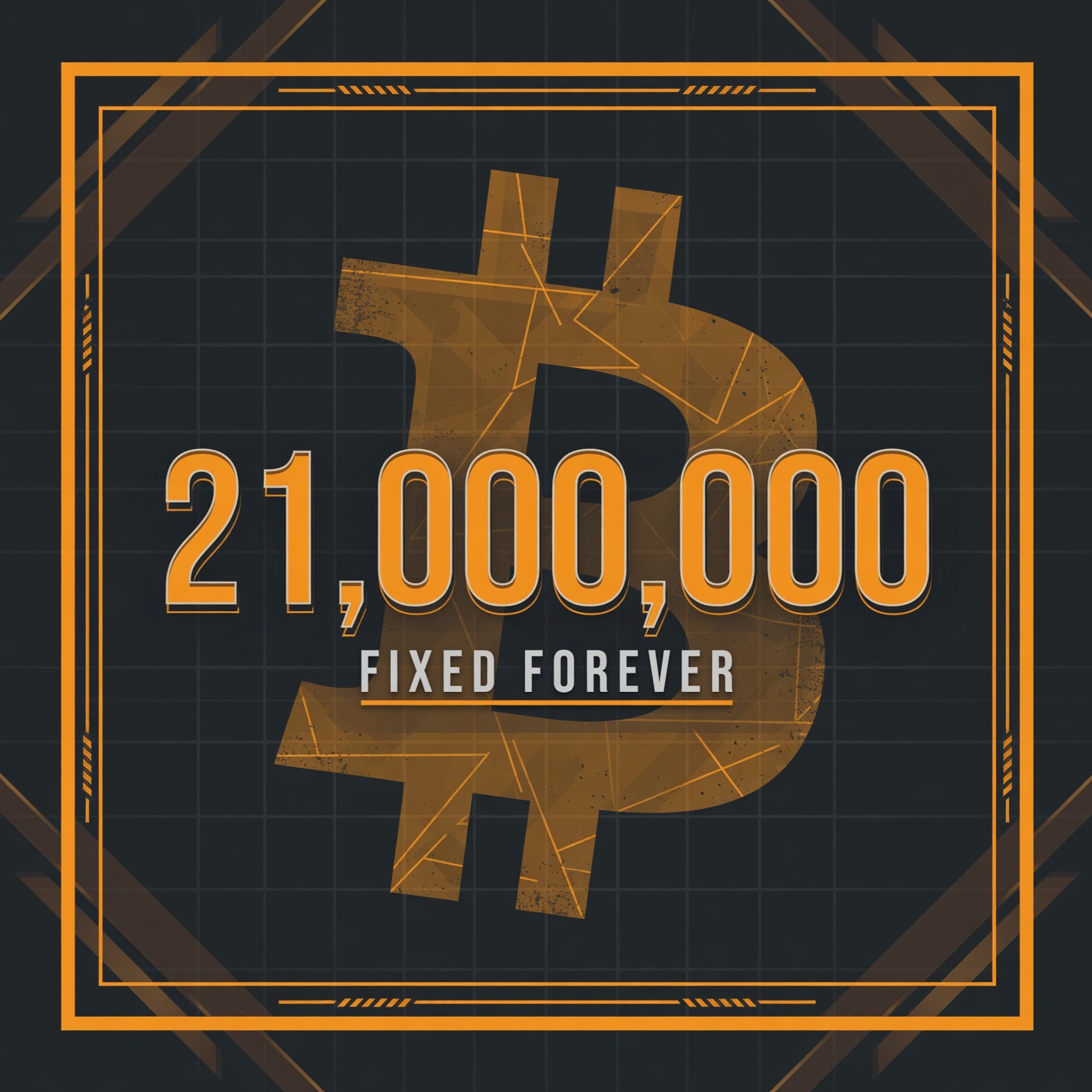
Bitcoin: The supply cap is 21,000,000 BTC. This is not a policy or a recommendation — it is hard-coded into the protocol. Every node on the Bitcoin network enforces this limit. To change it would require convincing thousands of independent node operators around the world to simultaneously adopt new software that breaks the most fundamental rule of the network. It has never happened. It is effectively impossible in practice. Bitcoin's scarcity is mathematically enforced.
Verdict: Bitcoin wins on supply certainty. No gold deposit, asteroid, or technology changes Bitcoin's cap.
2. Portability — Can You Move It?
Gold: A gold bar is heavy, physically traceable, and crossing borders with significant gold requires declaration, documentation, and faces confiscation risk. Transporting $1 million in gold requires armored vehicles. Wire-transferring the value of gold to another country involves financial institutions, wire fees, settlement delays, and counterparty risk.
Bitcoin: A Bitcoin private key — 256 bits of data — can be memorized, written on paper, stored in a USB drive, or transmitted to anywhere in the world with an internet connection. $1 million in Bitcoin moves in 10 minutes for a few dollars in fees. A refugee crossing a border can carry their entire net worth in their head. A business can settle international payments directly without a correspondent bank.
Verdict: Bitcoin wins on portability. There is no physical asset that competes.
3. Divisibility — How Precisely Can It Be Used?
Gold: Gold is divisible but practically limited. You can't pay for a cup of coffee with a gold bar sliver. Gold's historical use in small transactions required either coins (which were frequently debased by governments) or trust in intermediaries.
Bitcoin: Each Bitcoin divides into 100,000,000 satoshis (sats). At current prices, 1 sat is worth a fraction of a cent. Any amount of value — from a fraction of a penny to hundreds of millions of dollars — can be transacted precisely. The Lightning Network enables micropayments of a single satoshi.
Verdict: Bitcoin wins on divisibility.
4. Durability — Does It Last?
Gold: Gold is chemically stable. It does not rust, corrode, or degrade over time. A gold coin from ancient Rome is still gold. Durability is gold's most unambiguous advantage.
Bitcoin: Bitcoin is not a physical object — it exists as entries on a distributed ledger. As long as the Bitcoin network exists (and it has done so continuously for 17 years), Bitcoin is perfectly durable. However, individual Bitcoin can be permanently lost if the private key is lost or destroyed. Lost Bitcoin does not degrade — it simply becomes permanently inaccessible.
Verdict: Tie — with caveats. Gold requires physical security. Bitcoin requires key security. Different failure modes, same responsibility.
5. Verifiability — Can You Confirm Authenticity?
Gold: Gold can be counterfeited with tungsten-filled bars (same density). Professional verification requires sophisticated equipment — fire assay, X-ray fluorescence, ultrasound. Most individuals cannot verify gold without specialized tools or trusted intermediaries.
Bitcoin: Anyone with a Bitcoin full node (a ~500GB download running on a Raspberry Pi) can independently verify every transaction in Bitcoin's history, the supply, and the validity of any Bitcoin they receive. The verification is mathematical and exact — there is no forgery possible. Running a node yourself means you trust no one.
Verdict: Bitcoin wins on verifiability.
6. Fungibility — Is Each Unit Identical?
Gold: Pure gold is fungible — one ounce of .999 fine gold is interchangeable with any other.
Bitcoin: Bitcoin has a chain-of-custody history (the blockchain). Every UTXO (unspent transaction output) has a traceable history. In practice, most Bitcoin is fungible in ordinary transactions, but coins associated with illicit addresses can be flagged by chain analysis firms. Some privacy advocates argue this is Bitcoin's weakest property relative to gold.
Verdict: Gold has an edge on fungibility. Bitcoin's transparency is a tradeoff — you can verify everything, but so can others.
7. Censorship Resistance — Can Anyone Stop a Transaction?
Gold: Governments have confiscated gold. The US government confiscated private gold holdings in 1933 (Executive Order 6102). Physical gold at a custodian can be seized. Gold in a vault requires the vault's cooperation.
Bitcoin: A Bitcoin transaction broadcast directly to the network cannot be stopped by any government, bank, or corporation. There is no account to freeze, no custodian to compel. Bitcoin held in self-custody — not on an exchange — cannot be seized without the private key. This is not a claim about Bitcoin being used for illegal activity; it is a statement about property rights and financial sovereignty.
Verdict: Bitcoin wins on censorship resistance. No gold custodian can match the seizure-resistance of self-custodied Bitcoin.
The Institutional Comparison
Gold's market cap is roughly 10-15x Bitcoin's current market cap. If Bitcoin ever closes that gap — through institutional adoption, ETF access expansion, and the properties described above — the price implications are significant. This is the basis for many long-term Bitcoin price theses: not that Bitcoin replaces all gold, but that Bitcoin captures some fraction of gold's store-of-value market share.
The 2024 launch of spot Bitcoin ETFs gave institutional investors the same portfolio access to Bitcoin that they've had to gold ETFs (like GLD) for two decades. The Clarity Act furthers this by creating explicit regulatory frameworks for Bitcoin in institutional custody.
The Case for Each
Why Gold Still Matters
- 5,000 years of proof. Gold has been money across every civilization, currency regime, and technological era. Bitcoin is 17 years old. Track record is a genuine competitive advantage.
- Physical existence. Gold requires no internet connection, no software, no cryptographic key management. It exists in the physical world without counterparty or technical risk.
- Universal recognition. Every government, every central bank, every jeweler recognizes gold's value. Bitcoin's recognition is growing but not yet universal.
- Regulatory certainty. Gold's legal status is unambiguous in every jurisdiction. Bitcoin's regulatory environment is still evolving.
Why Bitcoin Offers Something Gold Cannot
- Mathematical scarcity. No miner, asteroid, or technology can produce more Bitcoin. Gold's supply can grow.
- Native digital settlement. Gold cannot move across the internet. Bitcoin's primary use case is digital settlement without intermediaries.
- Self-verification. You can prove exactly how much Bitcoin you own and its full transaction history. Gold requires trusted assayers.
- Seizure-resistant self-custody. A private key memorized is truly yours. Physical gold requires physical security.
What This Site Believes
bitcoin47.com is a Bitcoin-focused site, not a gold-focused site. We believe Bitcoin represents the most important monetary technology innovation of the modern era. We are not impartial.
But we are honest. Gold's track record, physical properties, and universal recognition make it a legitimate store of value. The Bitcoin vs. gold debate is not one-sided. Long-term, Bitcoin's supply certainty, portability, and verifiability position it as a superior store of value for the digital age — but the transition from gold to Bitcoin as the primary store of value is a multi-decade process, not an overnight flip.
Both can coexist. Many thoughtful investors hold both.
Cross-References
Bitcoin from first principles — why it was created, how it works, and what the fixed supply means for holders.
Read →The broader economic case for Bitcoin — fiat debasement, inflation, sovereign debt, and purchasing power.
Read →Saifedean Ammous traces the history of sound money from gold through fiat to Bitcoin — the definitive book for the Bitcoin vs. gold debate.
Amazon →Bitcoin's journey from a 2009 whitepaper to a $1T+ asset competing with gold as a store of value.
Read →Contains Amazon affiliate links — we earn commissions on qualifying purchases at no extra cost to you. Not affiliated with Donald Trump, any campaign, or any government office. Full disclosure →